
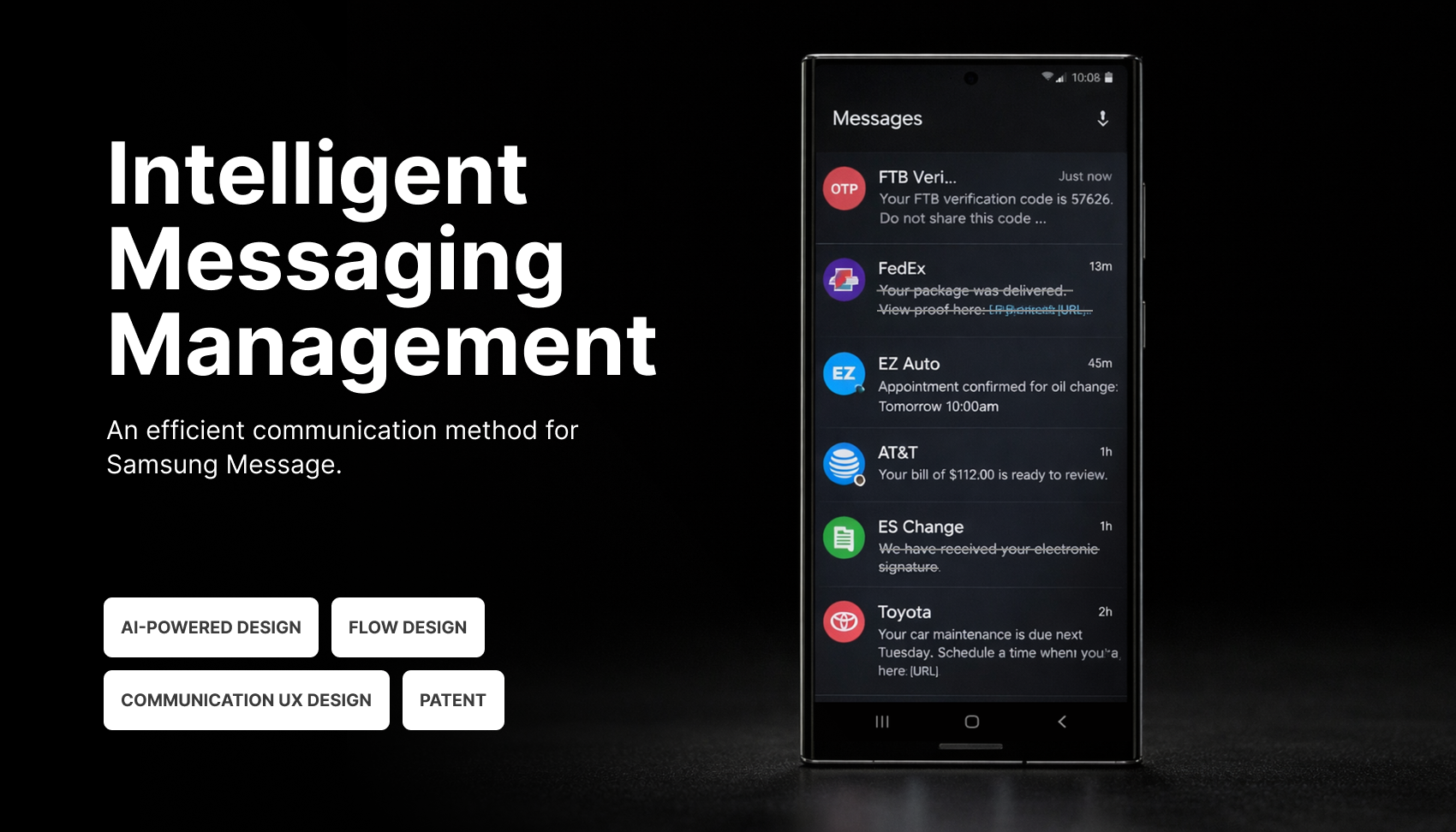
This project was filed and being patented on Feb 26, 2026: US20250373577A1
The moment the idea started

The idea did not begin with messaging. It began with dispatchers.
While working on the FNPTT (FirstNet Push-to-Talk) project, I observed dispatch operators managing emergency communication systems. Their screens continuously filled with incoming operational messages — status updates, confirmations, alerts, automated notifications.
Messages arrived faster than humans could meaningfully process them. Nothing was technically wrong. Yet something felt fundamentally broken.
Dispatchers were forced to repeatedly answer the same silent question: Does this message still matter?
Some messages were critical for seconds. Others for minutes. Most became irrelevant almost immediately. But the system treated all messages equally — permanently visible, permanently demanding attention.
A realization

Watching dispatchers work triggered a broader insight: This isn’t a dispatcher problem. This is everyone’s problem.
Every day, we receive: verification codes, delivery updates, appointment confirmations, automated service notifications…etc. Information designed to expire, but interfaces designed to remember forever. Our inboxes have quietly become graveyards of expired relevance.
That observation led to a question: What if systems understood not only what a message says — but how long it should matter?
From observation to concept

I began reframing messaging through a UX lens: Messages are not equal objects. They have lifecycles.
- OPT code: Seconds to minutes
- Delivery update: Hours
- Travel notification: Hours to days
- Regular human conversation: indefinite
Today, we manage these lifecycles manually — deleting, archiving, scanning, hesitating before removing messages. What seems like simple housekeeping is actually repeated cognitive work, accumulating into real user pain: notification fatigue, ongoing cleanup effort, anxiety about deleting important messages, and the mental load of distinguishing human conversations from system notifications.
Some messages have a predictable lifespan, but many do not, forcing users to constantly decide what still matters. The challenge isn’t just message volume, it’s the expectation that users evaluate the relevance of every incoming message.
Insights
Users don’t want more filters. They want less thinking. The opportunity isn’t smarter sorting. It’s a system that manages informational lifespan responsibly.
This led to the idea of an AI-powered messaging system capable of understanding message intent, predicting relevance, and automatically managing message lifecycles.
Experience concept design
Step 1 – Classify

When a message arrives, the AI first evaluates foundational signals:
-
Sender identity (human vs. application)
-
Whether an explicit lifespan exists (e.g., timeout or expiration information)
Messages such as OTP codes or system notifications often contain clear temporal constraints, allowing the system to immediately recognize their limited relevance.
Step 2 – Understand context and predict message lifespan

Instead of organizing messages solely by time received, the system prioritizes them based on expected relevance decay.
For messages with explicit time limits, such as verification codes or notifications indicating validity periods (e.g., valid for 15 minutes), the lifespan can be directly determined. However, many messages implicitly expire without stating a clear timeout. Delivery updates, reminders, or service confirmations may remain useful only until a task is completed.
For these cases, the system leverages AI-driven semantic analysis to interpret context and predict how long the information is likely to remain relevant.
Step 3 – Designing trust

Automation introduces risk. In messaging systems, a single incorrect deletion can permanently break user trust. To mitigate this, automated actions unfold progressively rather than instantly. When the AI determines that a message has likely expired, it is first marked with a strike-through state, signaling reduced relevance while remaining fully accessible.After a configurable period of N days, the message is permanently removed. Until then, all automated actions remain undoable, allowing users to restore messages and correct system assumptions.
Over time, these interactions inform future predictions, enabling the system to adapt to individual communication patterns and gradually earn user trust.
What can be metrics for success if it’s being implemented
- Reduction in manual deletions
- Reduced inbox size over time
- Lower time spent managing messages
Outcome
This design reframes messaging from passive storage to active lifecycle management. The patent describes technical mechanisms, and the UX opportunity lies in making automation visible, and treating trust as a product feature.
✅ Concept developed from real operational observation
✅ Scaled from mission-critical dispatch workflows to everyday communication
✅ Establishes a framework for lifecycle-aware AI interfaces
✅ Patented on February 26, 2026 (US20250373577A1)
Reflection
The most valuable insight from the FNPTT project emerged unexpectedly. High-stress environments reveal problems that already exist everywhere, just less visibly. Dispatchers experience message overload under pressure, while consumers face the same burden gradually in everyday communication.
Realizing the real problem helps reframe the design challenge. The question was no longer “Can AI classify messages?” but rather “How much decision-making are users comfortable delegating to AI?”
Human-Centered AI design begins when systems understand not only how to deliver information, but when that information has fulfilled its purpose while keeping users in control.